


















The stone people pick up when they didn't know they needed to slow down.
Caribbean Calcite shows up in the shop the way a long exhale does. People walk past the dramatic stones, the deep purples and the flashy pyrites, and their hand lands on this one without quite knowing why. Soft blue, cream, a little brown threaded through. It looks like the inside of a quiet morning.
There's a reason. This stone slows the breath without asking permission. You don't have to do anything with it. You just have to hold it.
I've watched it happen dozens of times now. Someone comes in keyed up about something, the kind of keyed up where their shoulders are sitting next to their ears, and they pick up a piece of Caribbean Calcite and forget to put it down. They keep talking, but the voice changes. The pace changes. That's the stone doing its work before anyone has read a single word about what it's "for."
It's a good one to keep where you sit and think.
Physical Properties
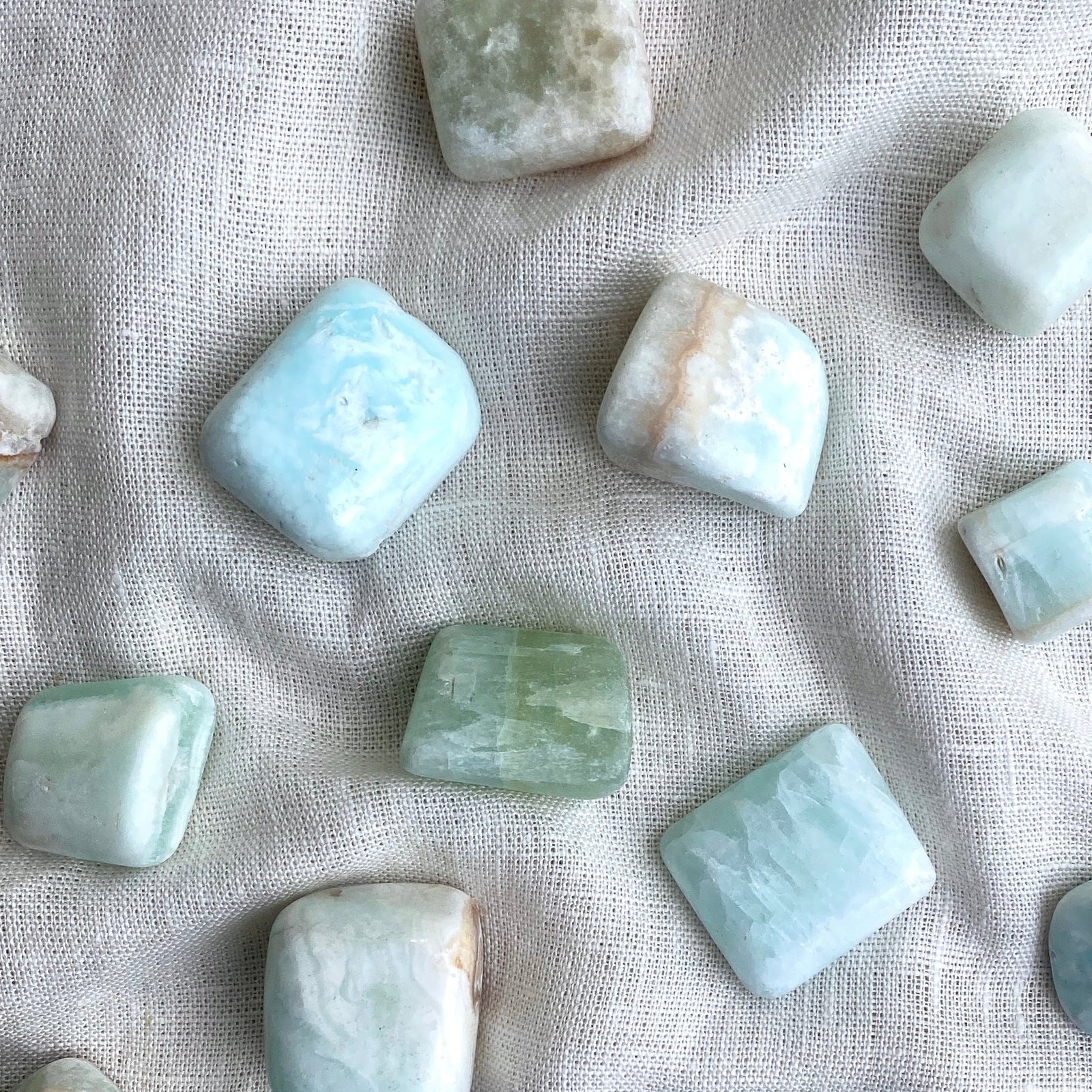
Appearance: Soft sky blue and creamy white in layered patterns, often with tan or pale brown banding running through. The blue is the calcite, the white and brown layers are aragonite. Natural variation between pieces is significant. Some show heavy banding, some are almost solid blue with a single cream stripe, some are mostly cream with blue pooling at the edges. Inclusions and natural lines are features, not flaws.
Composition: A natural pairing of blue Calcite and brown/white Aragonite, formed together as one stone. The two minerals have different hardnesses and absorb light differently, which is what creates the layered visual.
Hardness: 3 to 3.5 on the Mohs scale. This is a soft stone. It will scratch if you keep it loose in a pocket with keys, and it will dull if you scrub it. Handle it like you would a piece of pottery you actually like.
Origin: Typically mined in Pakistan. It's a relatively recent find on the crystal market, which is part of why it's still affordable for its visual impact.
Metaphysical Properties
What it does: Caribbean Calcite is a calming stone with a side of clarity. Blue calcite on its own is soothing. Aragonite on its own is grounding. Put them together and you get a stone that quiets the surface chatter and lets the deeper thinking come through. People reach for it during meditation, journaling, or any moment where the answer is in there somewhere but the noise is in the way.
Where it's useful: Anxiety that runs as background hum. Decisions that need quiet to land. Creative work that has stalled out under pressure. Moments where intuition is trying to speak and the analytical mind keeps interrupting.
Chakras: Third Eye for the intuition and clarity work, Crown for the wider connection. Not a primary "what it does" but worth knowing if chakra work is part of your practice.
How to Use Caribbean Calcite
On your desk or nightstand: This stone earns its keep just by being in the room. Put it where you do your thinking. The visual itself is calming, and the energetic effect doesn't require you to actively work with it.
In meditation: Hold a piece in your non-dominant hand. Let the breath slow on its own. No instructions, no chakra placement required - just hold it and notice what happens.
For journaling and decision-making: Set the stone next to the page. Useful when you're trying to hear yourself think and the noise won't quit.
As an altar piece: Larger pieces (towers, plates, free forms) anchor an altar visually and energetically. The color story plays well with selenite, moonstone, and clear quartz.
Crystal pairings:
- Selenite for clearing and lightening the atmosphere
- Moonstone to deepen the intuition piece
- Clear quartz to amplify what Caribbean Calcite is already doing
- Lepidolite if anxiety is the main reason you reached for it
- Black tourmaline if you also need a grounding anchor
Care and Maintenance
Cleansing: Smoke (cedar, rosemary, or your preferred herb), sound, or moonlight. Do not use water. Calcite is soft and porous, and water will dull or pit the surface over time.
Charging: Moonlight is the best fit. New moon or full moon, set it on a windowsill or outside if it's safe to do so. Avoid prolonged direct sunlight - calcite can fade.
Storage: Keep it in a soft pouch or on a shelf where harder stones won't bump it. If you carry a piece, keep it in its own small pouch.
Shopping Guide
Picking a piece: Caribbean Calcite is one of those stones where the body chooses well. Set a few pieces out and let your hand land. The "best" piece is the one you don't want to put down.
For tumbles: Look for visible layering between the blue and cream. A piece that's all one color is a fine starter stone, but the banding is what makes this stone what it is.
For larger pieces: Free forms, towers, and spheres show off the layering at scale. If you're choosing online, look for photos where you can see the color zones clearly.
On sourcing: Caribbean Calcite is typically mined in Pakistan. It's a newer stone on the market, which is good news for pricing and bad news for availability - good pieces move fast.
Here are some pieces that do this work well:
- Caribbean Calcite Tumble - the everyday piece, good for a pocket, a desk corner, or a starter stone
- Caribbean Calcite Triple Moon - large altar plate carved into a triple moon, when it's back in stock
More form factors of this stone are on the way to the shop. If a specific shape or size is calling, send us a note - we can usually find it.
One small thing to try tonight
Set a piece of Caribbean Calcite (or any blue stone you have) on your nightstand before bed. Don't do anything with it. Don't hold it, don't program it, don't ask it for anything.
Just let it be in the room while you sleep.
In the morning, notice if the first ten minutes felt any different.
That's it. That's the practice.