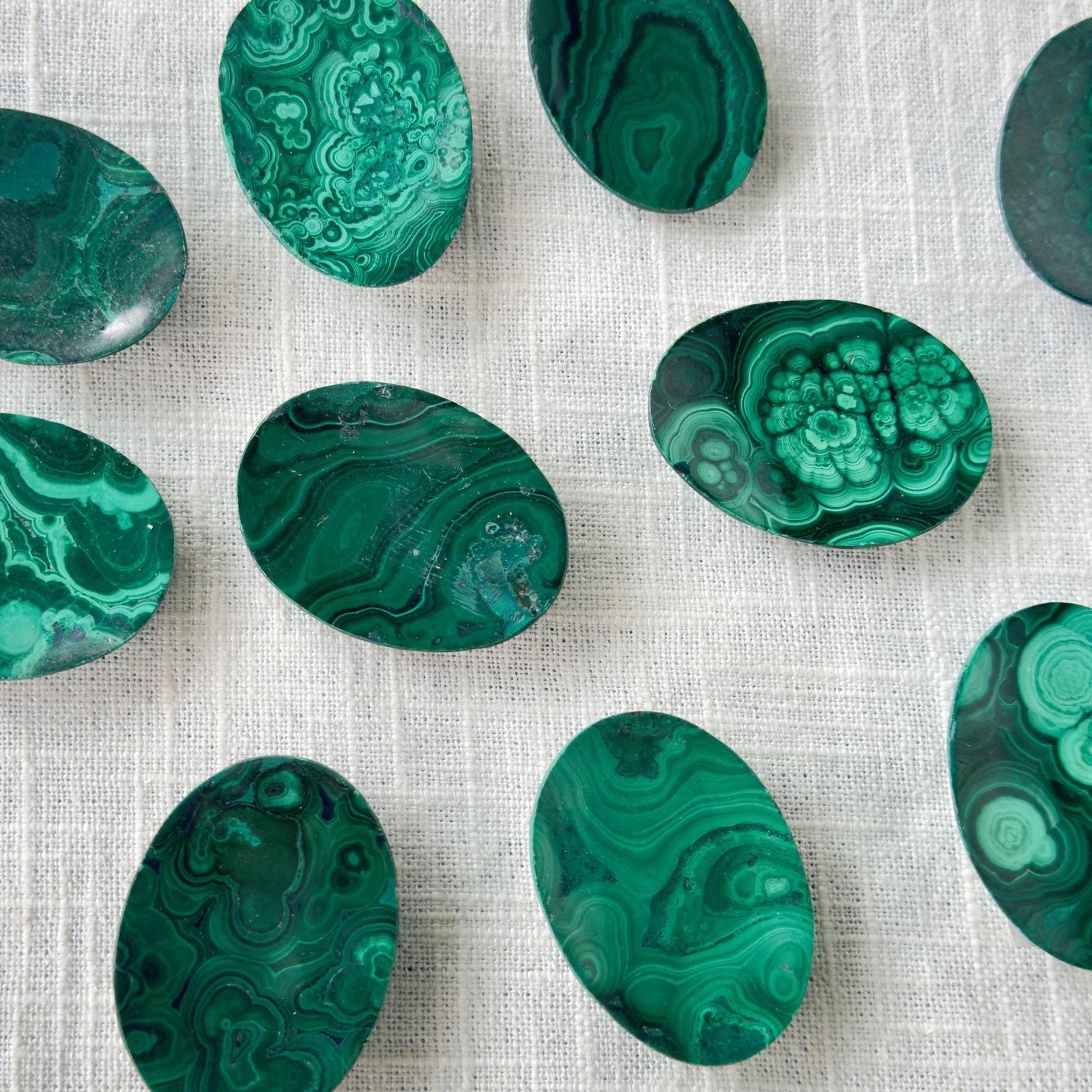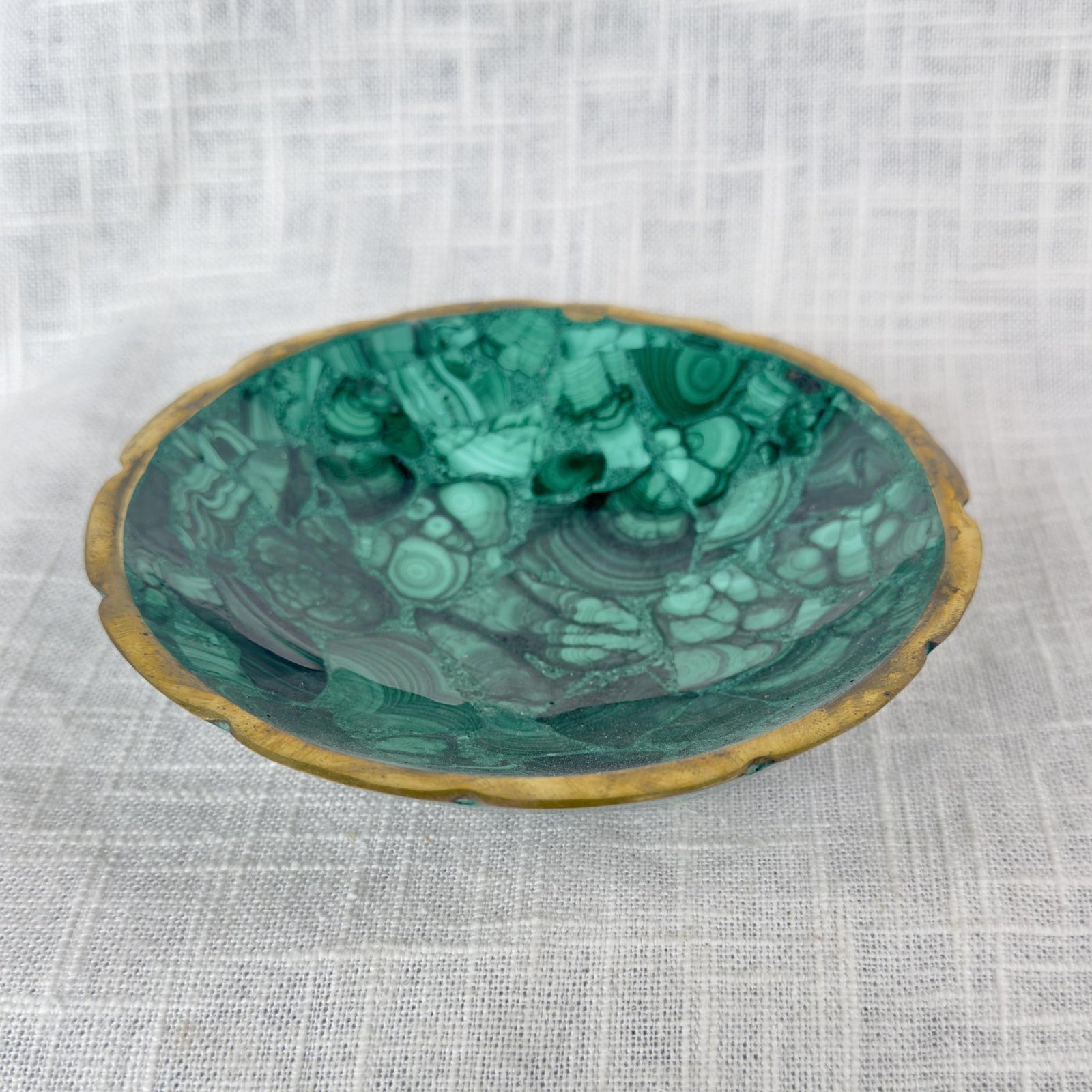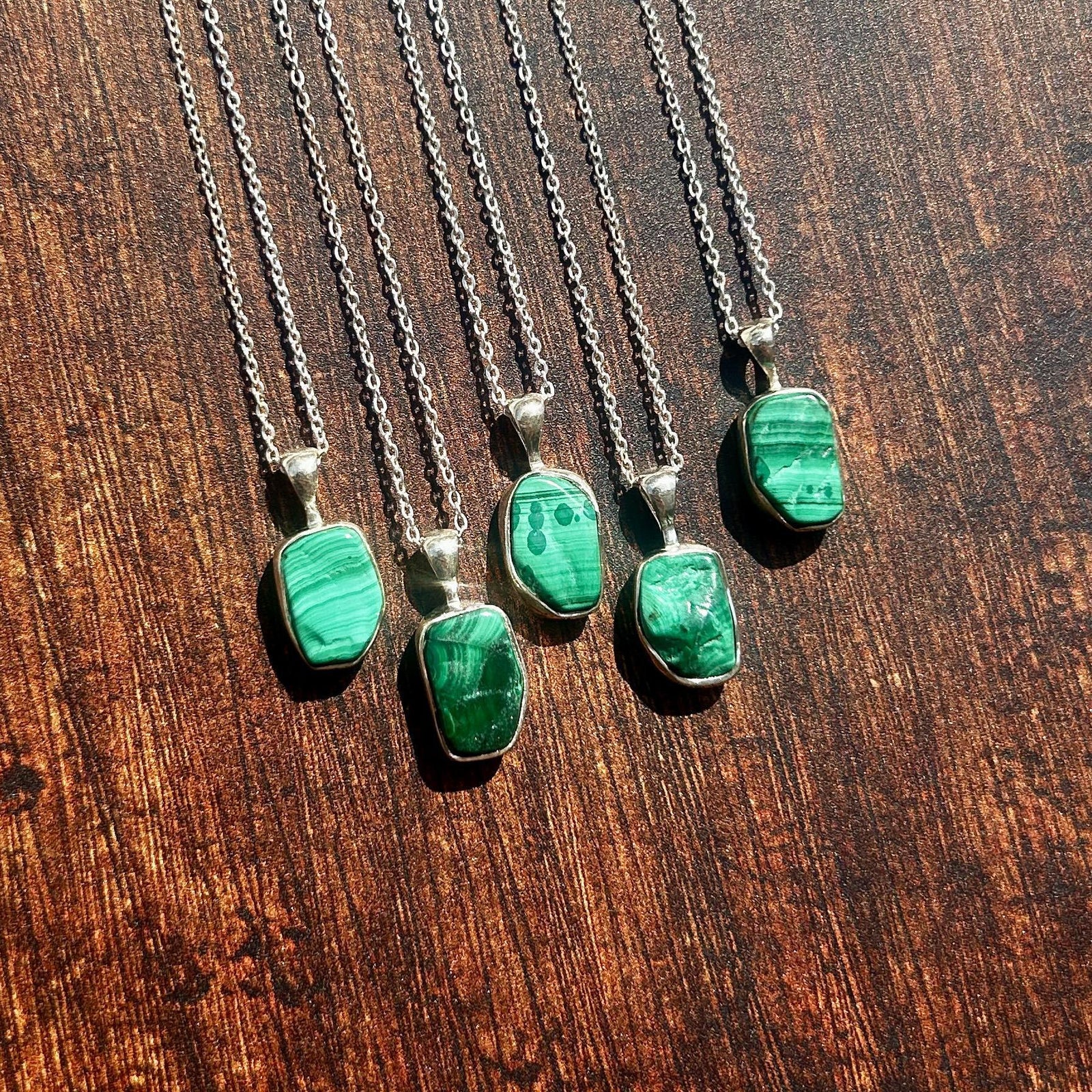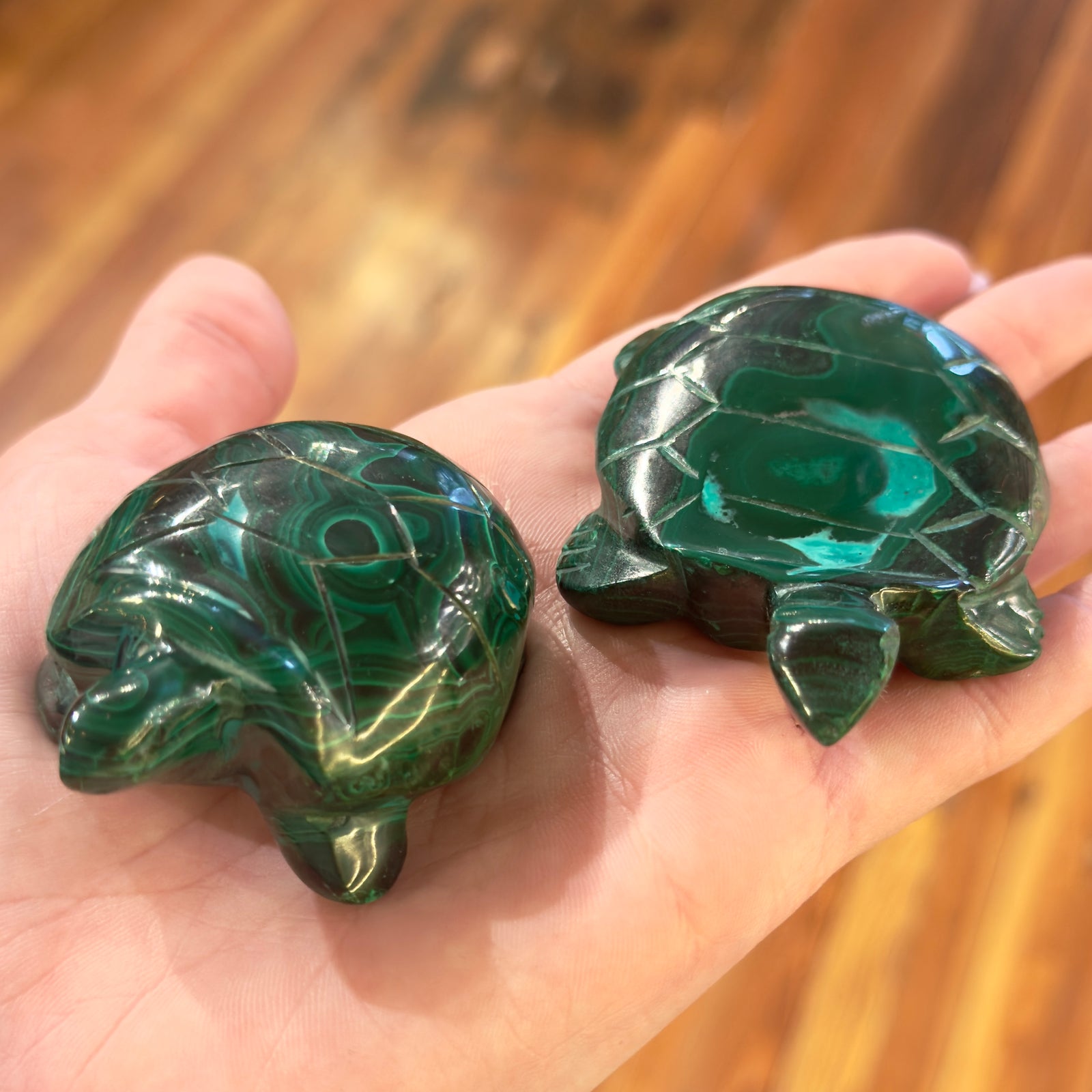



















The stone that asks you to look at what you'd rather not.
There's a reason malachite gets called the mirror stone. The banded green pattern shifts every time you turn it in your hand, and what shows up in the swirl tends to be whatever you've been avoiding looking at directly. People pick it up when something in their life is about to change and the change is the kind you've been postponing.
It's not a comfortable stone. That's the point.
Malachite is for the work that's already in motion under the surface. The conversation you keep almost having. The job you keep almost leaving. The pattern you keep almost breaking. The stone doesn't make the change happen, but it makes it harder to keep pretending it isn't already happening.
Hold one in your palm and notice what the green bands look like to you. Eyes. Rings. A landscape from above. The way it reads is usually a clue.
Physical Properties
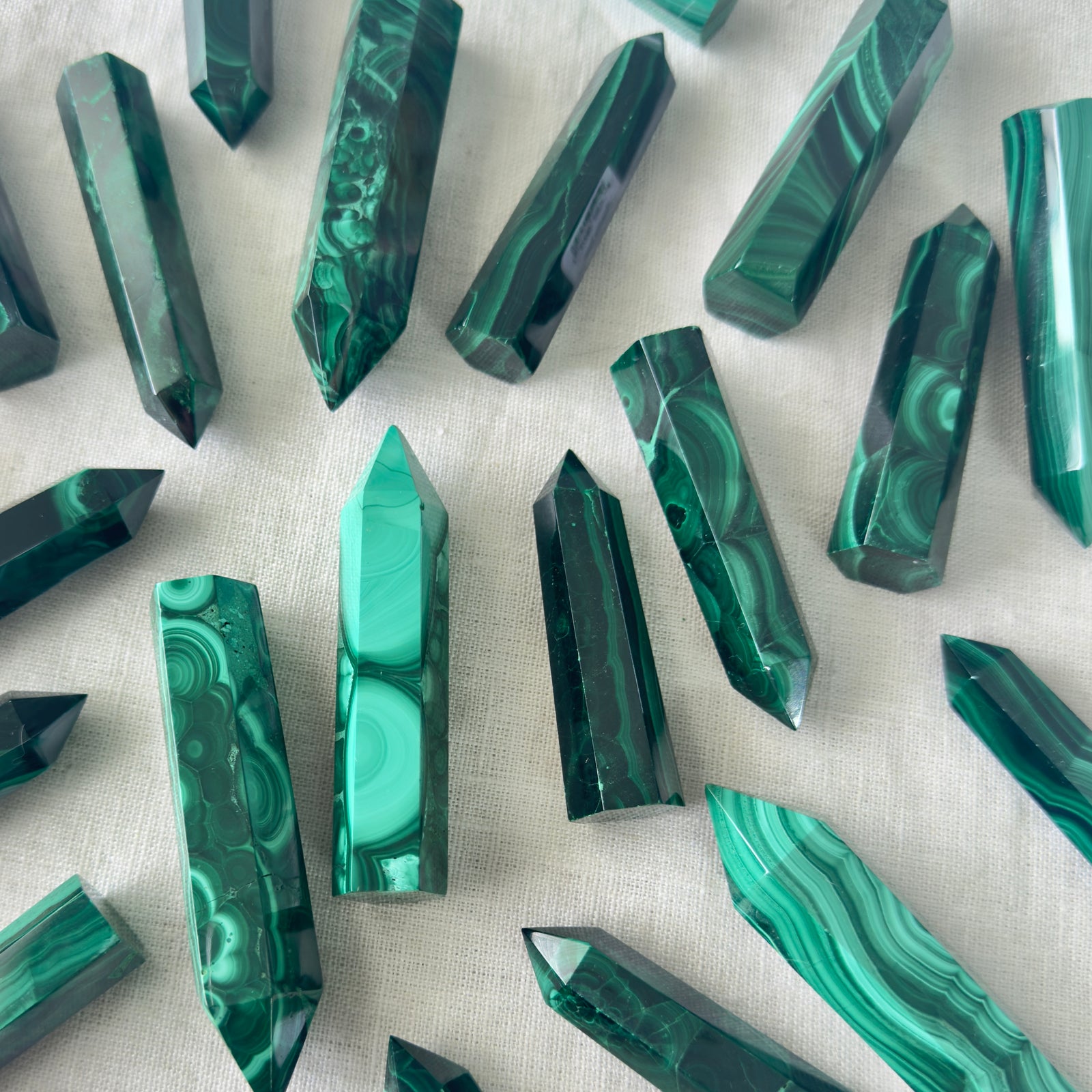
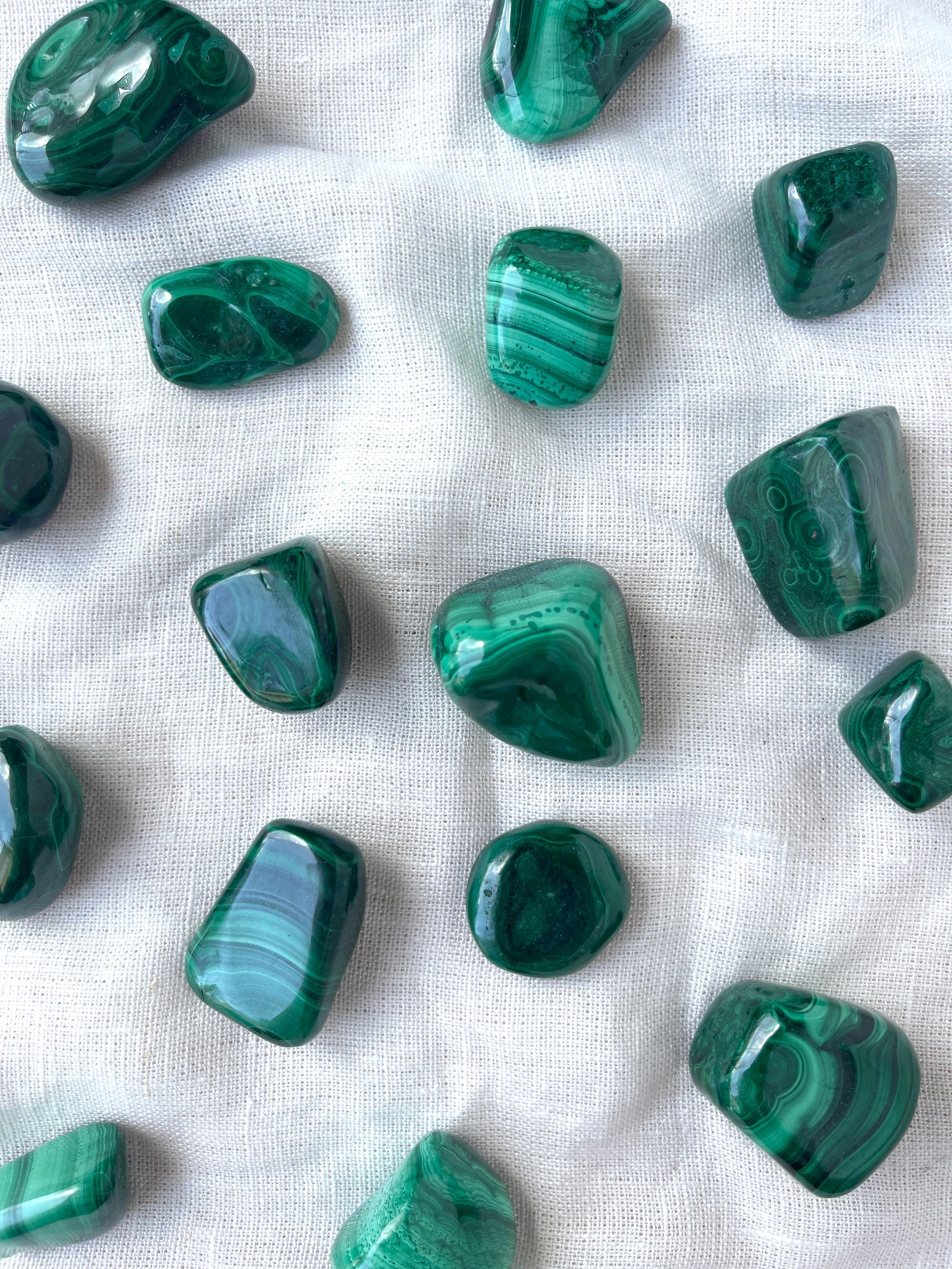
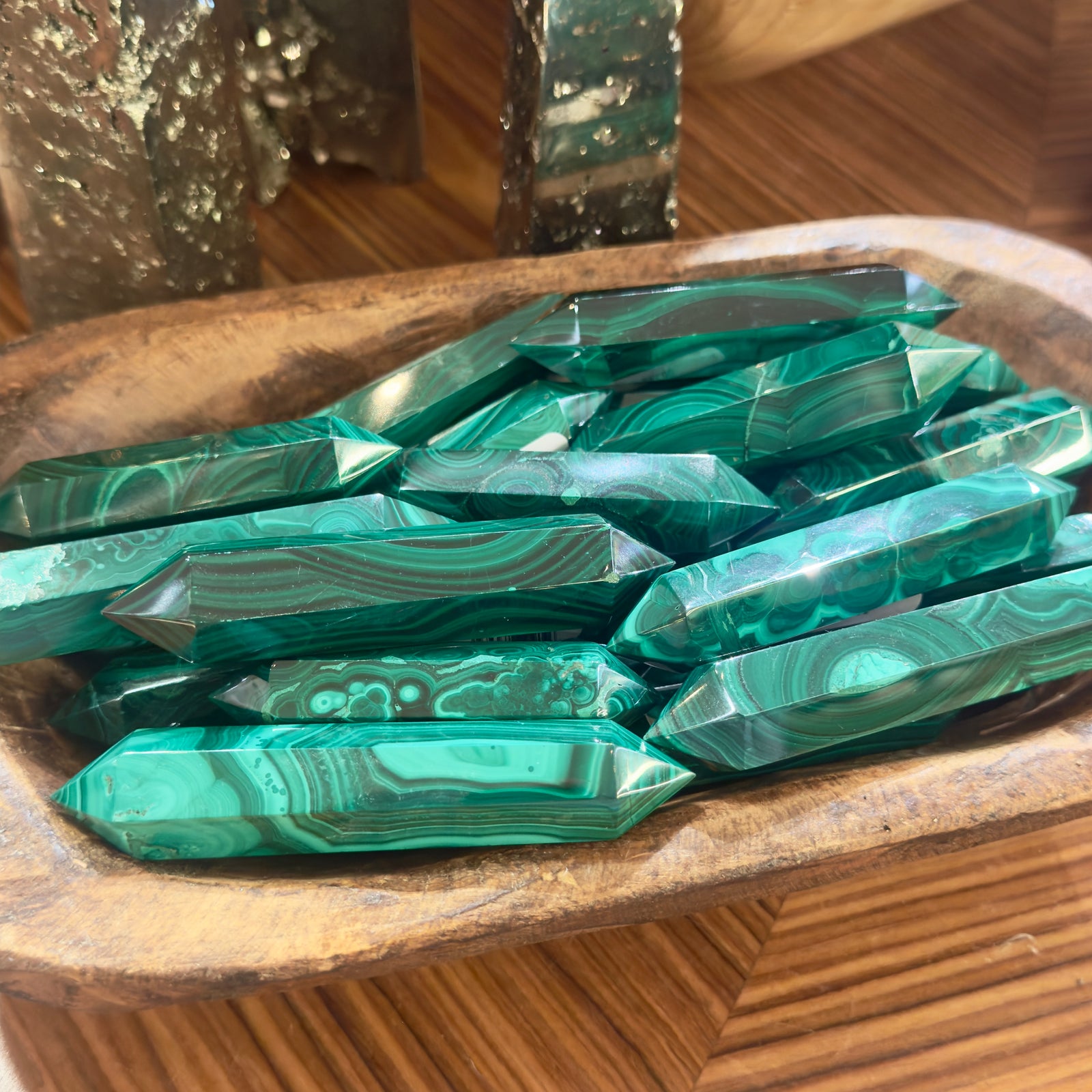
- Appearance: Deep emerald to forest green, banded in concentric circles and ribbons. Some pieces show eye-like patterns where the bands form rings around a central point. Every cut surface is different.
- Composition: A copper carbonate hydroxide mineral. The same copper content gives it the green color and makes it a stone to handle dry.
- Hardness: 3.5 to 4 on the Mohs scale. Soft. It scratches easily, polished or rough.
- Origin: Most malachite in the trade is mined in the Democratic Republic of Congo, with smaller deposits in Zambia, Russia, Australia, and Arizona.
Metaphysical Properties
- Reputation: The transformation stone. The one to reach for when something needs to come up to the surface before it can heal.
- Where it's useful: During life transitions. While processing grief or anger. When working on patterns inherited from family. When making a decision that's been postponed too long.
- Chakras: Heart and Solar Plexus. The heart for emotional honesty, the solar plexus for the confidence to act on what you find.
- Honest note: Malachite has a reputation for being intense. People who are not ready for what it brings up sometimes describe carrying it as exhausting. Start with a small piece and pay attention to how you feel with it nearby.
How to Use Malachite
- In your pocket: On days you're about to have a hard conversation, or about to walk back into a situation you've been avoiding.
- On your desk: As a paperweight on the project you keep not finishing. The visual reminder works.
- In meditation: Hold it loosely in your non-dominant hand and let the bands catch your eye. Don't try to interpret. Just notice what surfaces.
- For pattern work: A piece by the bed for a few nights while journaling about something inherited from your family of origin.
- In a grid: Centered with citrine for abundance work, or with rose quartz for relationship transitions.
- Pairings: Clear quartz to amplify, citrine to soften the edge with abundance energy, black tourmaline to ground if it feels intense.
Care and Maintenance
- Water: Avoid. Malachite contains copper and reacts with water over time. Wipe with a soft dry cloth only.
- Sunlight: Avoid prolonged direct sun. The color can fade.
- Cleansing: Smoke (rosemary, mugwort, cedar), moonlight, sound, or a selenite plate. Never a salt bath.
- Storage: Wrap in soft cloth. It scratches against harder stones in a shared dish.
- Handling: Wash hands after handling raw or rough malachite. The dust contains copper and shouldn't be inhaled or ingested.
Shopping Guide
A good piece of malachite has clear band definition and a deep saturated green. Banding that swirls in circles or eye shapes is more sought after than straight ribbons. Polished pieces show the pattern most clearly. Rough malachite (matrix still attached) is fine for an altar piece but harder to read.
Tumbles are a good starting point because they let you live with the stone before committing to a larger piece. Towers and spheres are for the desk or altar. Jewelry keeps the stone in contact with the body throughout the day, which some people find too much and others find exactly right.
On sourcing: most malachite at this price tier is mined commercially in central Africa. We work with vendors who can speak to where their material comes from, but full chain-of-custody is rare in this part of the market.
These pieces are good ones to start with, or to add to what you've already got:
- Malachite Tumble - the pocket-sized starting point
- Malachite Tower Intuitively Chosen - a small standing point for the desk or altar
- Malachite Bracelet - to carry the stone on the body through the day
- Malachite Stackable Rough Crystal Ring - rough stone set in metal, less polished read
- Malachite Frog Crystal Carving - a small carved piece for someone working on transition or rebirth themes
One small thing to try tonight
Set a malachite tumble on top of a piece of paper. On the paper, write down the one thing you've been almost-doing for too long. Leave it overnight. In the morning, read what you wrote out loud, then decide whether you're moving on it this week or letting it go.